
Starting strength training is hard. Two popular plans rule the gym: the Push-Pull-Legs split and the classic Full-Body routine. This blog post helps you choose the right plan for your fitness goals.
The Bottom Line Up Front: Which Should You Choose?
- Pick a Full-Body plan if you train two or three days a week. It hits your whole body fast.
- Pick a Push-Pull-Legs plan if you train four to six days a week. It gives muscles more recovery time.

Direct Comparison: PPL vs. Full Body
This simple chart shows how both gym plans compare for new lifters.
| Feature | Full Body Workout | Push-Pull-Legs (PPL) |
| Weekly Gym Days | 2 to 3 days per week | 3 to 6 days per week |
| Times Hitting Muscles | 3 times a week | 1 to 2 times a week |
| Time in Gym | 60 to 75 minutes | 45 to 60 minutes |
| Body Strain | High strain per workout | Low strain per workout |
| Best For | Busy schedules | Focused muscle growth |
What is a Full Body Workout?
A full-body plan hits all major muscles in one session. You train your chest, back, legs, and arms together.
How It Works
You split your training across the week. Most lifters train Monday, Wednesday, and Friday. This schedule gives your body 48 hours to rest between workouts. Relaxation helps your muscles to recover and grow.
The Benefits
- Train Muscles Often: Research shows that training muscles three times a week increases strength faster.
- Burn More Fat: Big exercises like squats require a lot of energy. This helps to burn calories.
What is a Push-Pull-Legs Split?
The Push-Pull-Legs split groups your muscles by how they move.
- Push: Chest, shoulders, and triceps.
- Pull: Back and biceps.
- Legs: Thighs, calves and glutes.
How It Works
You train one group while the other rests. Your chest rests while you train your back.
The Benefits
- Great Muscle Focus: You can train one muscle group hard without getting tired.
- Better Muscle Healing: Your chest gets four days of rest before you bench again.
The Muscle Growth Debate: Which is Better?
Both splits build muscle. Science says so. A study in a sports journal compared both plans. It kept total weekly work the same for both groups.
In the end, both groups built the same amount of muscle. The best plan is the one you can stick to every week.
What to Expect
How fast can you gain muscle naturally?
- Men: expect 1 to 1.5 pounds of muscle per month in your first year.
- Women: expect 0.5 to 0.75 pounds of muscle per month.
Do not try to rush this. Fast weight gain usually means fat, not muscle.
Detailed 3-Day Full Body Workout Plan
Here is a simple 3-day routine. It uses compound movements to build overall strength. Do not train on back-to-back days. Rest at least one full day between these workouts.
Exercise 1: Goblet Squats
- Target: Thighs and glutes.
- Volume: 3 sets of 10 reps.
- How to do it: Hold a dumbbell close to your chest. Keep your feet shoulder-width apart. Sit back like you are sitting in a chair. Keep your heels flat on the floor. Push through your feet to stand back up.
Exercise 2: Dumbbell Bench Press
- Target: Chest, shoulders, and triceps.
- Volume: 3 sets of 10 reps.
- How to do it: Lie down straight on a firm bench. Hold two dumbbells on top of your chest. Bring the weights down slowly until they touch the outside of your chest. Push the weight back up to the starting position.
Exercise 3: Lat Pulldowns
- Target: Upper back and biceps.
- Volume: 3 sets of 12 reps.
- How to do it: Sit on the pull-down machine. Hold the wide rod in such a way that your palms are in front. Pull the bar down to your collarbone. Squeeze your back muscles. Let the bar go up slowly.
Exercise 4: Romanian Deadlifts
- Target: Hamstrings and lower back.
- Volume: 3 sets of 10 reps.
- How to do it: Stand straight and place both the dumbbells in front of your thighs. Keep your legs mostly straight. Push your hips backward. Lower the weights along your shins. Stand up by squeezing your glutes.
Exercise 5: Dumbbell Shoulder Press
- Target: Shoulders and triceps.
- Volume: 3 sets of 12 reps.
- How to do it: Sit on a bench with back support. Hold dumbbells at your shoulders. Press the weights straight up over your head. Lower them back to your shoulders.
Detailed 3-Day Push-Pull-Legs Routine
Train three days a week with rest days in between. This plan lets you focus on specific muscle groups each session.
Day 1: The Push Workout
- Exercise 1: Dumbbell Bench Press – 3 sets of 10 reps.
- Exercise 2: Dumbbell Shoulder Press – 3 sets of 12 reps.
- Exercise 3: Triceps Overhead Extensions – 3 sets of 12 reps. Hold a dumbbell behind your head. Keep your elbows inward. Straighten your arms to lift the weight.
Day 2: The Pull Workout
- Exercise 1: Dumbbell Rows: 3 sets of 10 reps. Place one foot on the bench. Pull the dumbbells up to your waist. Keep your back straight.
- Exercise 2: Lat Pulldowns: 3 sets of 12 reps. Pull the bar to your chest to work your upper back.
- Exercise 3: Dumbbell Bicep Curls: 3 sets of 12 reps. Stand tall and curl the weights up. Keep your elbows tucked.
Day 3: The Legs Workout
- Exercise 1: Dumbbell leg press: 3 sets of 10 reps. Use a leg press machine in your gym.
- Exercise 2: Romanian Deadlifts: 3 sets of 10 reps. Focus on stretching your hamstrings.
- Exercise 3: Standing Calf Raises: 3 sets of 15 reps. Push through your toes to raise your heels.
The Secret to Success: Progressive Overload
You must make your workouts harder over time. This concept is progressive overload. Without it, your muscles will not grow.
You do not need to lift heavy right away. You can progress in easy ways.
Add Weight: When the existing weights seem too easy, use heavy dumbbells.
Add Reps: Try to do 11 reps instead of 10.
Improve Form: Exercise slowly to make the muscles work harder.
Keep a workout notebook. Write down your weights and reps for every single session. Try to beat your numbers every week.
Eating for Muscle and Strength
Your gym work is only half the battle. You must feed your body to see real changes.
The Role of Calories
If you want to build muscle, you must eat enough food. This is a caloric surplus. Eat slightly more food than your body burns each day.
If you want to lose weight, you must eat less food. This is a caloric deficit. Your body burns stored fat for energy.
Get Enough Protein
Protein is the building block of your muscles. Aim for one gram of protein per pound of body weight. You can get protein from chicken, beef, fish, eggs, and tofu.
Recovery: How Muscles Actually Grow
You do not build muscle while lifting weights. Lifting weights creates tiny tears in your muscle fibers. Your body repairs these fibers while you rest.
Prioritize Sleep
Aim for seven to eight hours of quality sleep each night. Your body releases growth hormones during deep sleep.
Drink Plenty of Water
Your muscles are mostly water. Dehydration makes you weak in the gym. Drink at least one gallon of water every day.
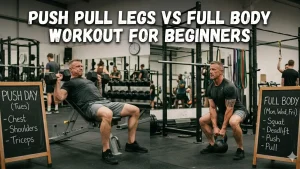
Complete 4-Week Schedule Templates
Here is how to structure your month. Use these calendar layouts to stay on track.
The 3-Day Full Body Schedule
- Monday: Full Body Workout
- Tuesday: Rest Day
- Wednesday: Full Body Workout
- Thursday: Rest Day
- Friday: Full Body Workout
- Saturday: Rest Day
- Sunday: Rest Day
The 3-Day Push-Pull-Legs Schedule
- Monday: Push Workout
- Tuesday: Rest Day
- Wednesday: Pull Workout
- Thursday: Rest Day
- Friday: Legs Workout
- Saturday: Rest Day
- Sunday: Rest Day
Frequently Asked Questions
Q: Can a beginner start with a PPL split?
A: Yes. Start with a three-day PPL plan. Do not do the six-day version yet. Your joints need time to adapt.
Q: Why is full-body better for busy schedules?
A: Missing a workout on a full-body plan is fine. You still hit those muscles later that week. On PPL, you miss entire muscle groups for two weeks.
Q: How do compound lifts protect your joints?
A: Big lifts train your shoulder muscles to work together. This balance builds joint strength and keeps you safe from injury.
Q: Do I need to buy protein powder?
A: No. You can get all your protein from real food. Protein powder is just a tool for convenience.
Q: How long does it take to see results?
A: You will feel stronger in two weeks. You will see physical muscle changes in six to eight weeks. Stay consistent to see real progress.